The History of Engraving in Calligraphy
Introduction
Engraving and calligraphy share a deep, intertwined history that stretches back to the earliest civilizations. The desire to make words permanent—to carve language into surfaces that would outlast the hand that formed them—is one of the most fundamental impulses of human culture.
In my years of teaching calligraphy in Puebla, I have found that students are often surprised to learn how closely engraving and calligraphy are related. The letterforms we practice with pen and ink were often first developed through the engraver’s burin. The elegant curves of copperplate script, the geometric precision of Roman capitals, the flowing rhythms of Arabic calligraphy—all were shaped as much by the engraver’s tools as by the scribe’s pen.
This exploration traces the history of engraving in calligraphy, from ancient stone carvers to contemporary artisans who keep these traditions alive.
Ancient Origins
Stone Carving and the Birth of Letterforms
The earliest engraved letters were carved into stone. Ancient Egyptian hieroglyphs, Mesopotamian cuneiform, and Chinese oracle bone inscriptions represent humanity’s first attempts to make writing permanent through engraving.
The Roman capitalis monumentalis—the majestic lettering carved into triumphal arches, temples, and public monuments—remains one of the greatest achievements in the history of letterform design. The proportions of these letters, carved into stone nearly two thousand years ago, continue to influence type designers and calligraphers today.
Key characteristics of Roman engraved capitals:
- Geometric proportions based on the square
- Serifs that originated as chisel-cut terminations
- Varying stroke widths that mimicked brush-drawn originals
- Careful optical adjustments for letters viewed from below
The Trajan Column in Rome, erected in 113 CE, bears an inscription that is still studied by lettering artists as the pinnacle of engraved letterform design.
Metal Engraving in Antiquity
Beyond stone, ancient artisans engraved letters into metal for seals, coins, jewelry, and ceremonial objects. Greek and Roman signet rings bore engraved monograms and symbols that served as personal identifiers. These tiny engraved letters required extraordinary precision and steady hands—qualities that define the engraver’s craft to this day.
The Medieval Workshop
Monastic Scriptoria and the Engraver’s Art
The Middle Ages saw an extraordinary flourishing of both calligraphy and engraving. In monastic scriptoria across Europe, scribes produced illuminated manuscripts of breathtaking beauty. But alongside these painted and inked works, engravers were creating their own masterpieces.
Engraved works of the medieval period:
- Tomb brasses — Memorial plaques engraved with lettering and portraiture
- Seal matrices — Metal dies used to create wax seals bearing names and symbols
- Liturgical objects — Chalices, reliquaries, and altarpieces engraved with sacred texts
- Armor and weapons — Decorative engraving on ceremonial arms
The Gothic Blackletter Tradition
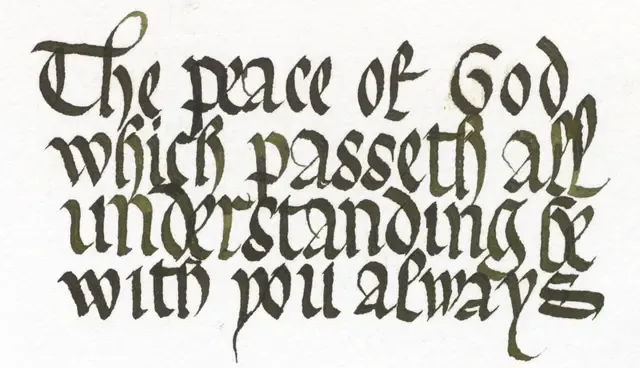
The Gothic script that dominated European writing from the 12th to the 15th century was particularly well-suited to engraving. Its dense, angular forms translated beautifully into carved stone and etched metal. The great cathedrals of Europe bear Gothic lettering in their stonework, and these engraved inscriptions remain some of the most powerful examples of medieval typography.
“The Gothic letter, with its fractured strokes and compressed forms, was the visual expression of an age that reached toward heaven in stone and glass. Engraved into cathedral facades, these letters became prayers made permanent.”
The Renaissance Revolution
Humanist Script and Classical Revival
The Renaissance brought a renewed interest in classical antiquity, and with it, a revival of Roman letterforms. Humanist scholars rejected the Gothic scripts of the Middle Ages in favor of cleaner, more open letterforms inspired by ancient Roman inscriptions.
Engravers played a crucial role in this revival. By studying and copying Roman inscriptions, they helped reconstruct the proportions and aesthetics of classical lettering. The work of Renaissance engravers like Felice Feliciano and Damiano da Moylle established new standards for engraved lettering.
Copperplate Engraving
The development of copperplate engraving in the 15th century transformed both printmaking and calligraphy. Engravers used a sharp tool called a burin to cut lines into copper plates, which were then inked and pressed onto paper.
This technique had profound implications for calligraphy:
- Reproduction — Calligraphic works could be reproduced and distributed widely
- Standardization — Engraved copybooks established standard letterforms
- Cross-pollination — Engravers and calligraphers influenced each other’s techniques
- Preservation — Master calligraphers’ works were preserved through engraving
The Great Calligraphic Copybooks
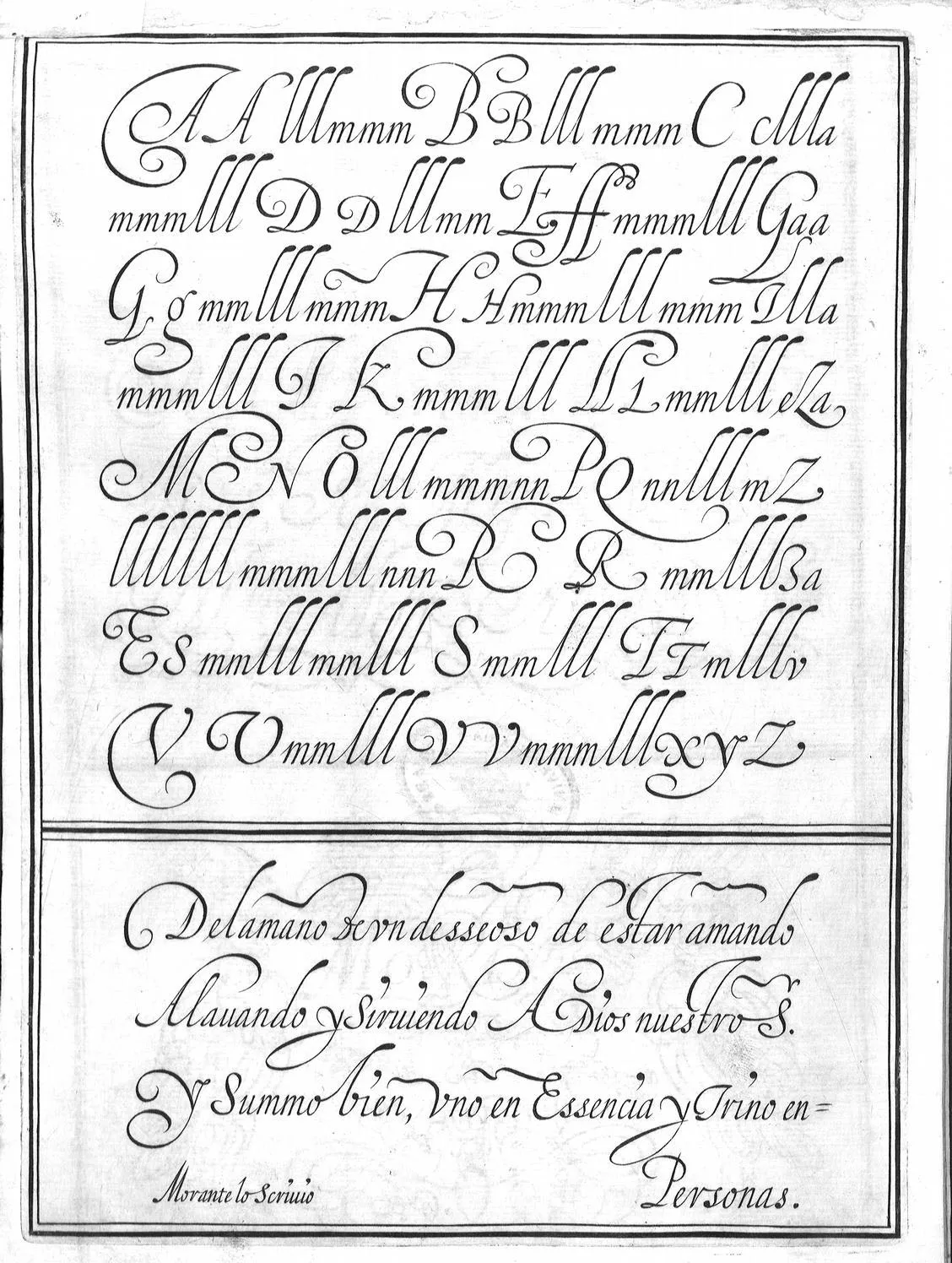
The 16th and 17th centuries saw the publication of magnificent calligraphic copybooks, engraved to preserve and disseminate the work of master calligraphers. These books were essential to the spread of calligraphic knowledge across Europe.
Notable engraved copybooks:
- La Operina by Ludovico degli Arrighi (1522) — The first printed writing manual
- Il Modo by Ludovico degli Arrighi (1526) — Further development of the chancery hand
- Theatrum Artis Scribendi by Jodocus Hondius (1594) — A comprehensive collection of hands
- L’Arte di Ben Scrivere by Giovanni Battista Palatino (1540) — Influential Italian manual
These engraved books preserved the work of master calligraphers for future generations and established the letterforms that would define Western calligraphy for centuries.
The Golden Age of Engraved Calligraphy
The 18th Century Masters
The 18th century represented a golden age for both calligraphy and engraving. The copperplate script—also known as English Round Hand—became the dominant hand for formal writing across Europe and the Americas. Engravers produced exquisite copies of calligraphic work, pushing the technical boundaries of their craft.
Characteristics of engraved copperplate:
- Extreme precision in hairline strokes
- Dramatic contrast between thick and thin
- Flowing, rhythmic connections between letters
- Elaborate flourishes and decorative elements
Engravers like George Bickham produced works of staggering beauty. His Universal Penman (1733-1741) featured plates engraved after the work of 25 master calligraphers and remains one of the most important documents in calligraphic history.
Bank Note Engraving
One of the most demanding applications of engraved calligraphy was bank note production. The intricate lettering on currency required engravers of extraordinary skill, as the lettering served both aesthetic and security functions.
Bank note engravers developed techniques that pushed the limits of human precision:
- Microscopic lettering visible only under magnification
- Guilloche patterns integrated with letterforms
- Multi-layered engraving creating tonal effects
- Latent images hidden within lettered areas
These techniques represent some of the finest engraved calligraphy ever produced, and the skills developed in bank note engraving continue to influence the craft today.
The Industrial Challenge
Photography and Lithography
The 19th century brought technologies that threatened the engraver’s craft. Photography could reproduce images without the engraver’s interpretive hand. Lithography offered a faster, cheaper alternative to copperplate engraving for commercial printing.
Many engravers adapted by finding new applications for their skills. Others saw their craft decline as mass production replaced handwork. The art of engraved calligraphy entered a period of uncertainty.
The Arts and Crafts Response
The Arts and Crafts movement of the late 19th and early 20th centuries pushed back against industrialization, championing handcraft and traditional techniques. Figures like William Morris in England and Gustav Stickley in America revived interest in handcrafted lettering and engraving.
This movement laid the groundwork for the 20th-century calligraphy revival and helped preserve engraving techniques that might otherwise have been lost.
Contemporary Engraving and Calligraphy
The Modern Revival
The late 20th and early 21st centuries have seen a remarkable revival of interest in both calligraphy and engraving. This revival is driven by several factors:
- Appreciation for handcraft — In a digital world, handmade work carries special value
- Wedding industry — Demand for engraved invitations and stationery
- Artistic exploration — Contemporary artists using engraving as a medium
- Educational resources — Workshops, online tutorials, and communities
Techniques in Contemporary Engraving
Modern engravers working with calligraphic letterforms use a range of techniques:
Hand engraving — The traditional method using burins and gravers. This produces the finest, most expressive results but requires years of training.
Pantograph engraving — A mechanical method that copies a pattern onto a surface. Used for consistent, repeatable work like trophy engraving.
Laser engraving — A digital method that uses lasers to etch surfaces. Fast and precise but lacking the warmth of hand engraving.
Diamond drag engraving — Uses a diamond-tipped tool to scratch letters into metal surfaces. Common for industrial marking.
For calligraphic work, hand engraving remains the gold standard. The subtle variations and expressive quality of hand-cut lines cannot be replicated by machines.
Engraving in Puebla
In Puebla, the tradition of hand engraving lives on in workshops throughout the historic center. Artisans engrave jewelry, religious objects, and decorative items using techniques passed down through generations. The intersection of these engraving traditions with calligraphy creates unique opportunities for collaboration and innovation.
I regularly work with local engravers to create custom seals, decorative plates, and special commissions that combine calligraphic design with engraved execution. These collaborations honor both traditions and produce work that neither discipline could achieve alone.
The Relationship Between Pen and Burin
How Engraving Influenced Calligraphy
The relationship between engraving and calligraphy is not one-directional. While engraving preserved and disseminated calligraphic work, it also influenced the development of letterforms themselves.
- Copperplate script evolved partly because engravers found certain letterforms easier to cut into copper
- Flourishing patterns were shaped by the capabilities and limitations of the burin
- Letter proportions were refined through the iterative process of engraving and correction
- New styles emerged when engravers interpreted calligraphic work through their own medium
How Calligraphy Influenced Engraving
Conversely, calligraphers have always looked to engraved work for inspiration:
- Copybooks provided models for practice and study
- Engraved monuments offered examples of letterforms at architectural scale
- Engraved ornaments expanded the calligrapher’s decorative vocabulary
- Historical engravings preserved letterforms that might otherwise have been forgotten
Learning Engraving as a Calligrapher
Getting Started
For calligraphers interested in exploring engraving, the transition is natural but requires patience:
- Start with soft materials — Practice on linoleum or soft wood before attempting metal
- Learn the tools — Understand the burin, graver, and their angles of attack
- Study historical examples — Examine engraved letterforms closely to understand technique
- Take a workshop — Hands-on instruction accelerates learning dramatically
- Practice daily — Engraving, like calligraphy, is a skill built through repetition
Essential Tools
- Burins and gravers — The primary cutting tools, available in various shapes and sizes
- Engraving bench and sandbag — For holding work securely at the correct angle
- Sharpening stones — Keeping tools sharp is essential
- Magnification — A loupe or magnifying lamp for detailed work
- Ink and paper — For proofing engraved work
Conclusion
The history of engraving in calligraphy is the history of humanity’s desire to make words permanent, beautiful, and meaningful. From the stone carvers of ancient Rome to the copperplate engravers of the 18th century to the contemporary artisans working in Puebla today, engravers have shaped the way we see and experience written language.
Understanding this history deepens our practice as calligraphers. When we form a letter with pen and ink, we participate in a tradition that has been refined through centuries of engraving. The proportions we use, the flourishes we add, the very shapes of our letters—all carry the imprint of countless engravers who cut, carved, and etched their way toward perfection.
I encourage every calligrapher to explore engraving, even at a basic level. The experience of cutting a letter into a surface—feeling the resistance of the material, controlling the depth and direction of each cut—provides insights into letterform design that pen and ink alone cannot offer. It connects us to our craft’s deepest roots and reminds us that calligraphy is not just about writing beautifully. It is about making meaning permanent.